We shape our tools and thereafter our tools shape us.
— Marshall McLuhan
Sangong topic discussion 5 | The desire behind artificial objects
Preface
In the contemporary context, people inhabit a world designed by humans. Humanity’s transformation and creation of the material world is in essence the projection and practice of desire. Media and technology are not only the material presentation of human desire; they are the fundamental force that has reshaped human cognitive paradigms, social structures and cultural textures. From the functional aesthetics of everyday objects to the large-scale planning of urban space, design, as an invisible discourse of power, continually permeates and reconstructs our lived experience. Faced with ever more complex systems of artificial objects, how should artists think about and use these material carriers? This question led us to explore artificial objects and the mechanisms of desire behind them.
Artificial objects carry complex human intentions and desires. In philosophy, the relation between material things and human desire has long been an important question. Baudrillard pointed out that in contemporary consumer society, objects have long since gone beyond their practical functions to become sign-carriers of desire and identity. An ordinary luxury handbag is not merely a container; it is a concrete expression of social status, identity and personal desire. Henri Lefebvre deepened this discussion from the perspective of everyday life. In The Production of Space he argued that space is not a neutral container but the result of social production. The ways space is organised, from urban planning to interior arrangement, all reflect particular social relations and operations of power.
Yet this relation between people and artificial objects often only becomes visible from a particular perspective. As Heidegger argues in Being and Time, when a tool works well it is “invisible” to us: we do not notice the knife unless it becomes blunt or loses its proper balance. Only when a tool breaks down or loses its function do we become aware of its existence. This phenomenon reveals the complex interaction between people and the material world.
Many artists have explored the relation between people and things in different ways, including re-examining the meaning of everyday objects. Duchamp’s Fountain (1917), for example, offered a new critical perspective by turning an ordinary urinal into an artwork. It revealed how the meaning of objects is constructed by social context, and opened a possibility for later artists to explore the readymade.
This critical thinking about artificial objects has also found an echo in contemporary design. As design practice has deepened, the designer’s role has shifted from mere problem-solver to problem-finder and social critic. Designers represented by Anthony Dunne and Fiona Raby create fictional products to question existing social norms and values, prompting the public to think about the relation between technology and society. This idea of design as a tool of social critique resonates with contemporary art’s attention to social issues, bringing art and design into closer relation at the levels of both function and concept.
This topic aimed to reflect on how artificial objects come into being by understanding design thinking, and to cultivate a “second pair of eyes” for observing the everyday. Through role-play and other performance practices, we took part in discussion from the perspective of artificial objects, exploring the relation between objects and people and the similarities and differences between art and design, so as to understand more deeply the social structures and human desires hidden behind artificial objects.
Text / Ruoxi Ren
Critical Theory in Design Thinking
Design is no longer associated simply with objects and appearances, design is increasingly understood in a much wider sense as the human capacity to plan and produce desired outcomes.
— Bruce Mau
The development of critical theory and practice in design thinking is an important dimension where design meets contemporary art. Contemporary design is shifting from pure problem-solver to catalyst for cultural dialogue, and this shift brings it ever closer to contemporary art in its critical thinking. Three theoretical frameworks, Critical Design, Design as a Third Culture and Discursive Design, show the key trajectory of this evolution.
As a practice, Critical Design can be traced back to 1994, when Anthony Dunne and Fiona Raby pioneered it at the Royal College of Art in London. In 1997 Dunne first set out the concept of “Critical Design” systematically in his doctoral thesis Hertzian Tales, published in 1999. Critical Design holds that design should go beyond functional solutions and instead create objects that provoke thought and discussion. In their 2013 book Speculative Everything: Design, Fiction, and Social Dreaming (Figure 1), they set out the theoretical framework and methodology of speculative design systematically. By creating “alternative” designed objects, this theory questions existing design paradigms and explores further possibilities for design. The approach is especially close to conceptual art within contemporary art: both stress the ideas and the critique behind the work.
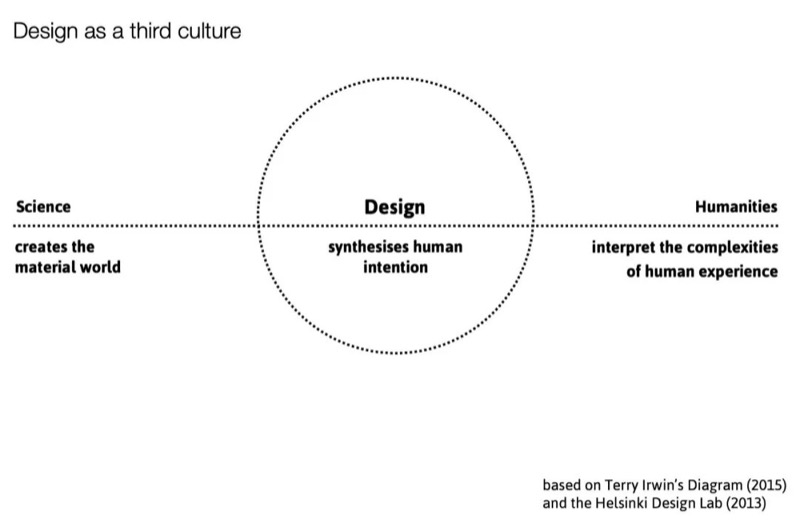
The theory of Design as a Third Culture was proposed by the Helsinki Design Lab in 2013 and developed further by Terry Irwin in 2015, as a distinct field outside science and the humanities (see Figure 2). The theory positions design as a third form of culture alongside science and the humanities, stressing that design has its own way of knowing and its own cultural value. In the diagram the three fields are not completely separate but interrelated. A dotted circle places design at the centre, showing that design acts as a bridge between science and the humanities, able to connect material creation with humanistic interpretation. This positioning shows that design neither belongs wholly to science nor is merely humanistic expression, but is a distinctive, integrative practice. The theory brings out design’s integrative character: it can use scientific methods and make room for humanistic concerns while keeping its own way of thinking and logic of practice. This positioning gives design a particular place in contemporary culture, and provides a theoretical basis for dialogue between design and art.
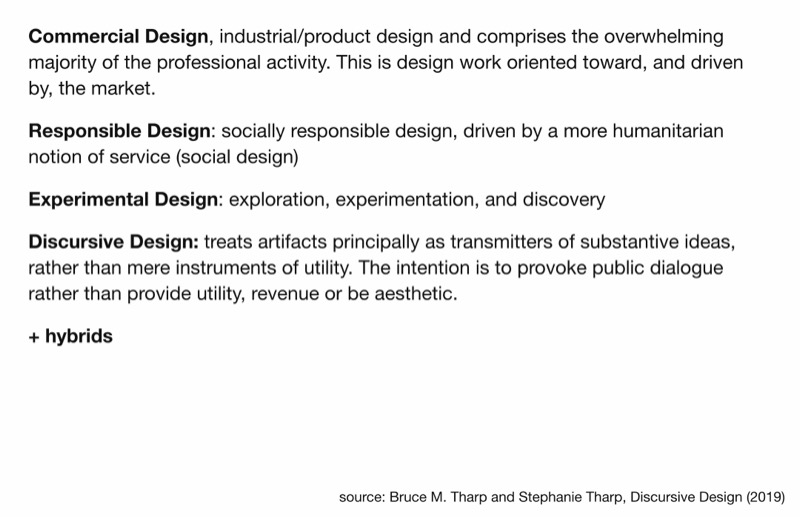
The theory of Discursive Design was set out systematically by Bruce and Stephanie Tharp in 2019 in Discursive Design: Critical, Speculative, and Alternative Things. It treats designed objects as carriers of ideas and proposes a typology of commercial design, responsible design, experimental design and discursive design (Figure 3). Discursive design especially stresses the designed object’s role as a medium of cultural dialogue, a pursuit it shares with socially engaged practice in contemporary art. In this framework, design attends not only to the function and aesthetics of objects but even more to their dialogic and critical role in social and cultural contexts.
These theories are all closely connected to contemporary art practice. Such designs often take the form of installations to express critical thinking, sharing an expressive language with conceptual art and installation art. The theory of the third culture reveals the symbiotic relation between design and art in cultural creation, stressing their complementary roles in building culture. Discursive design further blurs the boundary between design and art, stressing the designed object as a carrier of cultural discourse. Through these theoretical developments we can see design breaking free of traditional functionalism and moving towards greater criticality and cultural depth, which is also how it learns from, and evolves together with, contemporary art practice.
Related works / Reference
No Place Like Home: the designer Dominic Wilcox created a pair of shoes that know where they are going. LEDs set in the toe of the left shoe, connected to a smartphone by Bluetooth, point the wearer in the direction of home.
The Toaster Project: the designer Thomas Thwaites tried to make a toaster from scratch. Over this nine-month project he mined iron ore, refined plastic and made the parts by hand himself. The finished toaster looks crude, yet it fully documents the complexity of industrial civilisation. Through a simple everyday object, the work reveals the vast scale and high specialisation of the modern production system.
Homeless Vehicle Project was born in New York in the 1980s, when Wodiczko designed a multi-purpose vehicle for people living on the street. This unusual device could store personal belongings, give its user shelter, and even collect waste for recycling to earn an income. Although the work uses a pragmatic design language, its real aim was to draw public attention to the plight of the city’s homeless people, showing how design can intervene in social issues.
Teddy Bear Blood Bag grew from an unsettling inspiration: researchers at the University of South Florida had developed a “flesh-eating robot” that could turn biomass into electricity through microbial fuel cells. Taking this as a starting point, the designers asked: “What if this technology really did develop? How would things change? Would people and animals be exploited in new and terrible ways, or would there be laws to protect them?” They answered with a work full of tension: an FM radio powered by a teddy-bear-shaped blood bag. It approaches the ethics of technology from an unusual angle and uses the language of design to make it seem friendlier and more acceptable, striking a subtle, humorous balance between gentleness and sharpness.
These examples show that over the past decade designers have paid more and more attention to everyday matters. A pair of shoes that never get lost, a hand-made toaster outside industrial production, a vehicle for the homeless, a blood-powered children’s object: these projects by innovators in design question habit, transform the ordinary and blur the boundary between form and function. They make tools that were in a “hidden state” “appear” again, creating an “alternative reality”. This method of making familiar objects strange was in fact already practised in the Dada period.
MAN RAY (1890‑1976), Cadeau, 1921, editioned replica 1972. Iron and nails.
& fig. an iron that can also be a feminist weapon
Take the work in the image above: I have given it two different captions.
The work is Man Ray’s Cadeau (Gift, 1921), a classic of Dada. In this readymade made of a flat iron and nails, the nails are welded to the base of the iron, turning an ordinary household object into one charged with violence. Seen from another angle, it can also be read as an everyday object called a “feminist weapon”.
In the same way, a public toilet can be a city-dweller’s meditation room; a lift can be a transporter of class, or a vacuum zone of sociality; a rubbish bin can be the terminal of urban civilisation, or an archive of human consumerism…
Discussion and practice on artificial objects
1. Object analysis methodologies
Who designed the object?
Is the object interesting?
Does it look interesting?
Was it made by interesting people? Does it have any interesting functions?
…
What is its material or background?
What does it look like, and why?
What is it made of, and why?
Who made it? When and how was it made?
How is it consumed or used, and by whom?
…
2. Performance
“Without desire, I am nothing…”
This was a special kind of meeting. Each participant played a self-defined artificial object: a blank sheet of paper, a river in the city, a chair, a cushion, a watch, a hole in a sock, a pair of glasses, an electric wheelchair.
Participants entered their chosen roles completely, began by saying “Without desire, I am nothing…”, and then moved into improvised, natural conversation, exploring together the overlooked poetry and contradictions of the material world.
(About two hours long; excerpts below.)
/
Blank paper: Any form of desire can be vented on me, with no moral restraint. Nobody will say, you shouldn’t [do that] to a blank sheet of paper, you can’t cut a blank sheet of paper. But no one would casually smash a pair of glasses, or snap a stool, or pour hand soap into the water. Those are the things I’m so jealous of. I hope that one day moral restraints for blank paper, laws against people’s wicked deeds towards blank paper, will be enacted…
Glasses: You have a close relative, A4 paper.
Blank paper: He’s been disciplined! I don’t treat him as a brother any more. If it were just me, fine, just me, I’d do whatever I wanted… I’ll print all of you first. Whether you can print me, I don’t know, but I’ll print all of you; if you all want to print me, I’ll print you all, and tattoo you all over!
/
Electric wheelchair: I need my host to control me. Most of the time I’m pushed to the back of everyone’s mind; I only get used when my host becomes disabled and then has a strong desire to move.
Glasses: So they always need something from you. Are you much desired? You must feel noble? Do you hope your host stays disabled forever?
Electric wheelchair: I hope he’ll hand control over to me. I could suddenly speed up while my host is sitting on me. Steps are the most evil things, the thing I can least control. Is there any difference between me and a chair? It must be some distant cousin of mine? Are you a generation above me?
Chair: <laughs>
Glasses: But your personalities seem so different. You must be the child of a chair and a car.
/
Watch: Last time I secretly got a group of friends to walk together, slower and slower… A few months later they gradually began to feel, hmm, something seems a bit off? So I think if we move slowly enough, and invite all the watches in the world to act together, maybe that could change the world…
River in the city: Make them believe that reality and truth have split apart. You really should do that! That’s what I want. Maybe then they’d put me back into nature.
Blank paper: The day the sun comes up at midnight, everyone will go mad.
River in the city: Maybe then you’ll be free too.
/
Blank paper: I want my kind to be able to define themselves!
Hand soap: You mean, if you want to define yourself, you first have to deny that you’re a sheet of paper?
Blank paper: I think I need to progress; my thinking needs to progress; I need a breakthrough. I’m limited and defined by my host. Once I break through the definition, I’m not paper any more!
Cushion: But it occurs to me that blank paper said at the start that it only came into being after its host gave it this definition and concept. So if it wants to define its own existence, is it possible that it could never have existed in the first place? So you have to make yourself exist first, and only then can you define yourself.
Blank paper: Hmm… that’s the self-referential proposition I mentioned earlier.
/
Hole in a sock: I don’t even know where I exist now. Because as a hole in a sock, I never had a childhood, never… I’ve started to doubt my identity.
Glasses: Are you a trace? I mean, when your host saw this thing and it reached a certain size, they defined you as “a hole in a sock”. I think this helps to tell whether you were born unconsciously or consciously… What can you be used for? Could you become a glove, or a scarf? If you became infinitely large, you would disappear.
Watch: Have you thought about cutting yourself in two at the waist and turning yourself into a thread?
Hole in a sock: I don’t get it.
Glasses: Suicide.
/
Cushion: My host and I get on well. Now and then I quietly shift my angle a little so he’s less comfortable, but if he insists on trying to get along with me, he turns me into the shape he wants, and so I slowly lose my feelings for this person. I don’t really have much self-awareness.
Glasses: I feel the cushion is closer to its host; with body heat and smell, there seems to be a kind of intimacy.
Cushion: I don’t know what I look like myself now; I always look different. But later I found that I have the same smell as my host, the same temperature, the same shape, a feeling of being nested together.
I once thought I might be a coat, because I go to many places, but then I realised I don’t go out with him the way his other coats do, so for long stretches I couldn’t see many people. I observe my own features. Sometimes I get holes too, but even when I do, perhaps because my host has feelings for me, he doesn’t throw me away, so I’m probably not a pair of socks. I’ve noticed I often see the sofa and the door. So my rough guess is that I might be a cushion, attached to this solid furniture to make it more comfortable and softer.
River in the city: Have you ever thought of rebelling?
Cushion: With most of the hosts who have touched me, I began with an attitude of fondness. So I did think of rebelling. But later, through long contact with them, I was slowly tamed; I couldn’t turn that last feeling into liking them, so I became the shape they wanted. Perhaps I lost that part of my rebellious spirit. I think I have fondness, but not much self-awareness, because I think “fondness” is also a kind of self-awareness; liking or disliking a person is self-awareness. I think I’m a process that goes from having self-awareness to self-awareness disappearing. Still, I don’t feel pessimistic.
After today, maybe one day I’ll imitate, or turn into, a sheet of paper. Because I want to know: did I become myself because I completely accepted human desire? Because my present state is very self-consistent. So I want to know whether I’m like this because I perfectly received human desire, or whether my existence is self-consistent in itself. If I became the opposite of myself, say thin and fragile, would I still be allowed to exist?
/
Hole in a sock: Hand soap, you’re different from us; you’re not made of just one material. And you don’t exist in just one state. You can squeeze out your liquid, and you also have a shell. It’s as if you share two states of existence at once. What do you think?
Hand soap: I remember that when I introduced myself I said I’m hand soap; I didn’t mean the bottle that holds the hand soap. This shell can be changed, but my sense of my own identity isn’t because [I have] no shell, so, so this is a particular possibility.
River in the city: When all of you has been squeezed out, is it outside or inside?
Hand soap: Personally I lean towards this: the part that has been squeezed out has already left me. Like you said, leaving doesn’t mean you went out; it means it left.
Glasses: But hand soap and the hand-soap bottle, the bottle of hand soap, doesn’t seem to be that kind of relation. Hand soap without a bottle, isn’t it still hand soap?
Cushion: Does it make any difference to you whether the shell is transparent or opaque? When your blood has run dry, would someone keep trying to use you up, because they don’t know you’re dead?
Hand soap: When I’m empty, even if I’m not opaque, the shop assistant picks me up, puts me down, sees I’m empty. They might even [unclear in the transcript] fill me with water and pretend I’m still hand soap. It’s more like this, I think: as long as I’m still taken by others as a tool for cleansing their bodies, I’m hand soap.
Hole in a sock: If you only serve the function of helping others wash their bodies, then, as you just said, if water is put in you, you can still exist as hand soap. That means you don’t necessarily need the ingredients of hand soap to exist. Suppose I just give you a bottle filled with any liquid; that’s enough. You don’t actually have to do anything. So if you ask for my analysis, you exist there more because of this bottle that holds liquid. It’s as if the bottle is holding liquid inside the hand soap…
Glasses: Mm, this bottle that holds liquid is a bottle with a very strong sense of self.
Cushion: What if you were squeezed into a mineral-water bottle? What would you think?
Watch: What if you were squeezed into a mineral-water bottle and then a hand-soap pump was screwed on?
Hand soap: That depends on what the mineral water thinks.
/
Cushion (to hand soap): I think you’re a human, a human disguised as this hand soap. How do you put things back in their places and turn them into signs? From a human point of view.
Hand soap: “When we are artificial objects, me as hand soap and you as a cushion, won’t you allow us to think in a human way?
Yes, I think I often [unclear in the transcript] come to Sisyphus. Apart from the river in the city, everything present here is something we made. In fact we are not very alike, because we cannot, in physical space, act on our own behalf with agency; most of the time we are carried here and there, pushed around, squeezed. But in fact, Sisyphus’s existence is built on his own situation. There is no way out at all; his acceptance is his resistance.
I agree with Sisyphus, because I think that for our identity this is the most positive, the most thorough state: real struggle. Other forms of resistance that seem to have a great effect on the host are in fact rather powerless in the face of this realisation. I think perhaps we should, at root, accept our situation while still bravely facing it, rather than denying our own nature and imagining ourselves in a heaven that doesn’t exist. That would be a kind of shrinking back instead.