Editor’s note
AI Life-Objects is a contemporary art course for undergraduate sculpture students at the academy, taught by Ruoxi Ren.
The course starts from a concrete question: AI has entered everyday life, so how should artists face it? There are two common answers: one is to learn to use it, the other is to resist it. Both answers share the same premise: AI is a tool. This course wants to step around that premise. We call AI a “life-object”. This does not mean that AI has life or consciousness. It means that, like a living organism, it sustains itself through matter, energy and relations, and is always changing. It deserves to be studied as an object, not only used as a tool.
Around this proposition, the essay unfolds in three steps, each answering one question: what parts make up AI (the mereological shift); what relations hold these parts together (the relational shift); and, once they are connected, how it acts (the performative shift). The three steps build on one another; together they form a way of looking at AI anew.
0 | The illusion of the tool
Every conversation with a large language model (LLM) begins with the same picture: a white dialogue box and a blinking cursor. You type, you wait, a reply appears. ChatGPT, Claude, Gemini, Yuanbao, Kimi: the interfaces are much alike. What you cannot see is that, in the few seconds while the cursor blinks, a whole computing infrastructure spanning continents is running. You cannot see it because it has been designed so that you cannot.
Martin Heidegger offers a ready-made pair of concepts for this. Being and Time distinguishes two kinds of relation between people and things:
- Zuhanden (ready-to-hand): the state in which a thing is used smoothly. In a skilled hand the hammer “disappears”; the carpenter thinks about the nail, not the hammer.
- Vorhanden (present-at-hand): the hammer breaks or jams, and it suddenly jumps out of the action and becomes something that has to be looked at. Only then do we begin to ask: what is it?
All the effort of interaction design over the past few decades can be summed up as keeping every artificial object permanently in the “ready-to-hand” state. Devices don’t fail, software doesn’t throw errors, AI answers every question. Technology appears only in the form of a service, never in the form of a “thing”.
LLMs have pushed this kind of design to its peak. But as long as it stays smooth, we never ask what it really is. The question disappears inside the success of the design.
The intervention contemporary art can make is to reverse this process: to bring AI back from “ready-to-hand” to “present-at-hand”, from a handy tool back into a thing that has to be looked at. The first question of that looking is: what kind of thing is it?
1 | The first shift: where are the boundaries of AI?
Start with an everyday thing. Where are the boundaries of the phone in your pocket?
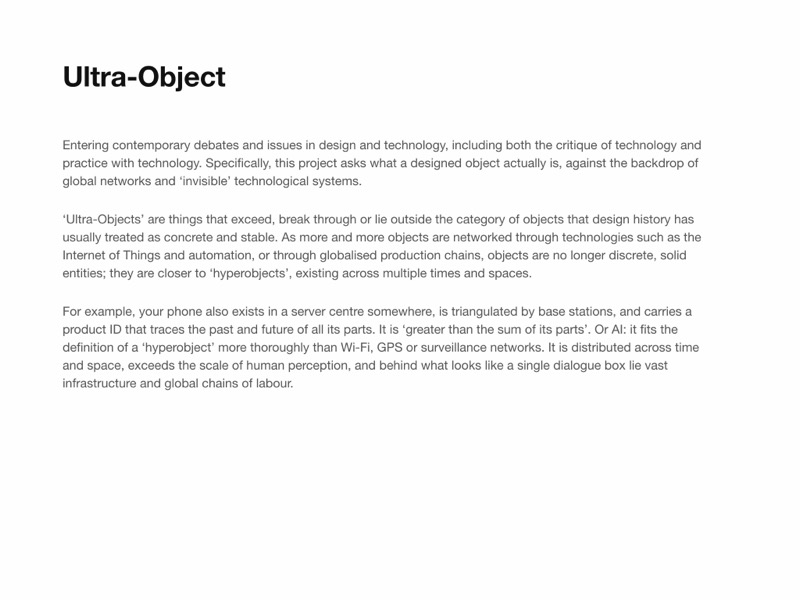
By common sense, a phone’s boundary is its case. A hammer is a wooden handle plus an iron head; the parts of a thing should all be in front of us. In philosophy this kind of question is called mereology, the study of parts and wholes. But the phone does not obey common sense. It is in your hand, and also in a server a thousand miles away (your cloud backup), in the location records of a nearby base station, and in the product codes of a supply chain spanning continents. Its parts are scattered across the globe. To say it is “greater than the sum of its parts” is not rhetoric but fact.
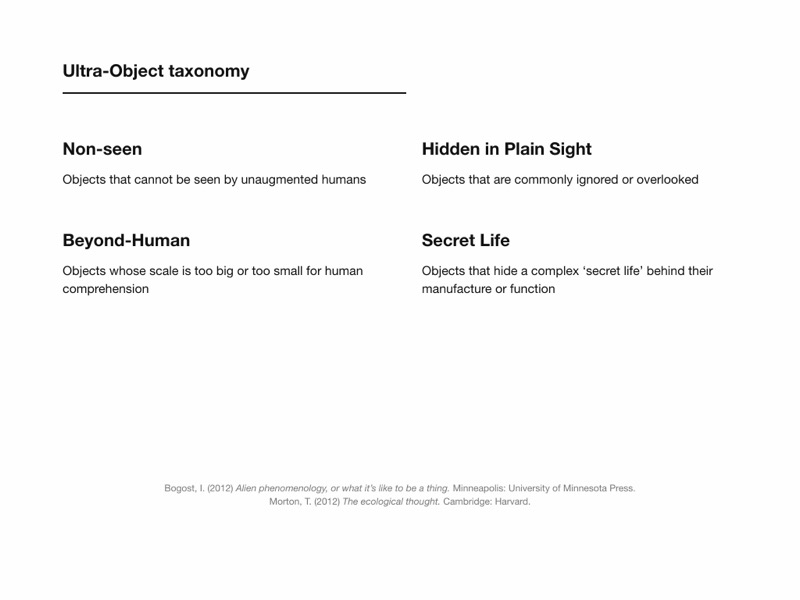
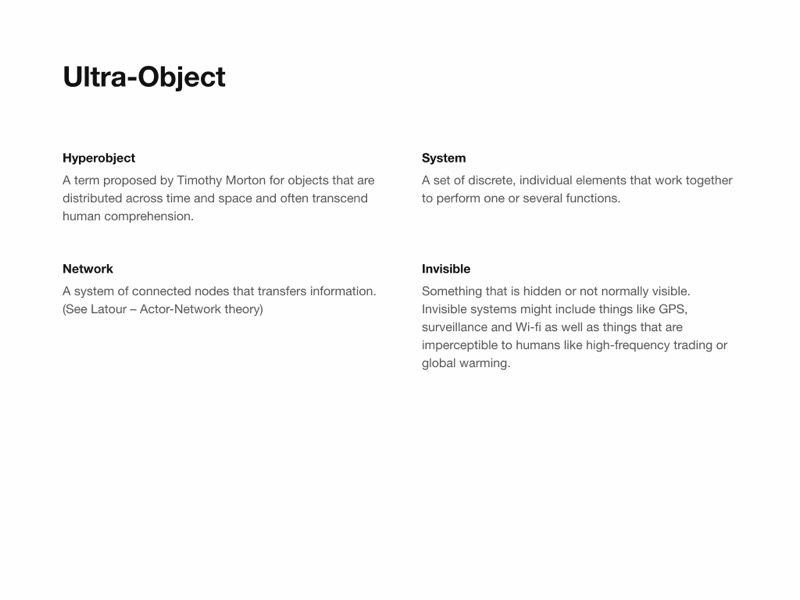
A term circulating in British design teaching calls this kind of thing an Ultra-Object: when objects are connected to one another through networks, automation and global production chains, their boundaries disperse and they become entities spanning multiple times and spaces. The term falls between two better-known concepts. At one end is Timothy Morton’s hyperobject (2013), anything too large to be perceived as a whole, with climate change as the standard example. At the other is Benjamin Bratton’s The Stack (2015). Bratton argues that planetary computation has piled up into an “accidental megastructure” that can be read in layers, like a network protocol: User, Interface, Address, City, Cloud, Earth. Six layers, from the fingertip all the way down to the mineral strata. Bratton calls computation at this scale planetary computation; it is one of the most active concepts in current debates in the philosophy of technology.
Morton speaks of phenomena, Bratton of totality, and the “Ultra-Object” sits in between: it is specifically about artificial things, about how a designed thing overflows its own boundaries.
Put together, the three terms can locate AI clearly. A phone is one vertical cut through the Stack: starting at the fingertip and digging all the way down to the mineral layer. AI is a more radical cut: every conversation passes through all six layers at once. The dialogue box looks like one thing; behind it is the whole megastructure.
An object like this cannot be depicted in ordinary ways. It needs a new kind of diagram.
Kate Crawford and Vladan Joler’s 2018 Anatomy of an AI System does exactly this. Starting from an Amazon Echo speaker, the work spreads the whole depth from fingertip to mineral layer across one giant diagram: rare-earth mines, undersea cables, training corpora, annotation workers, the electronic waste left after disposal and the toxins that seep from it. The diagram is neither an engineering drawing nor a sociological chart; it tries to draw the entire existence of an AI system onto a single plane.
In 2023 the two completed Calculating Empires: a black-ground atlas installation twenty-four metres wide that adds a five-hundred-year timeline to this depth. Colonial sea routes, telegraph networks, prison systems and data centres are joined on the same scroll into a history of mutual shaping. The work won the Silver Lion at the 2025 Venice Architecture Biennale. Joler and the philosopher Matteo Pasquinelli later made the position of this line of work explicit: every map is only a partial perspective, and to draw a map is to take a position (Nooscope, 2020). The diagram is no longer the work’s instruction manual; the diagram itself has become the work, and a work with a position.
There is also a reference currently on view in Shanghai: Diagrams (AMO/OMA, 2026) at Prada Rong Zhai gathers more than 150 diagrams from the twelfth century to the present. The exhibits come from every period and culture and address every kind of object; again and again, people have drawn diagrams to understand and order the world. They have nothing to do with AI, and for that very reason they serve as corroboration: using diagrams to know and study objects is a practice spanning eight centuries, and diagrams have never been neutral. The exhibition happened to coincide with the course, and the diagrams in it also became material for discussion in class.
2 | The second shift: what relations generate AI?
After the question of boundaries comes the question of relations: what connects the scattered parts into a whole?
Actor-Network Theory (ANT), proposed in the 1980s by Bruno Latour and others, gives a radical answer, often called a relational ontology in the literature. Its claim can be stated in one sentence: reality is not divided into “people” on one side and “things” on the other; every reality is a network formed jointly by humans and non-humans. Microbes, documents, legal provisions, algorithms: anything that can produce effects in the network counts as an actant. The combinations in a network that have become fixed, whose insides no one questions any more, Latour calls black boxes. The “ready-to-hand” state described in the previous section is the everyday form of the black box.
Seen through ANT, the picture of “a user using a tool” falls apart. In front of the screen there is no isolated “you” using an isolated “it”. There is only a network: you, the prompt, the training corpus, low-paid data annotators, GPU clusters, cooling water, capital, regulations. These actants work together to produce the moment called “a conversation”.
The landmark event of ANT entering art was the 2005 exhibition Making Things Public: Atmospheres of Democracy, co-curated by Latour and Peter Weibel at ZKM in Germany. The exhibition did not display objects; it displayed how objects are drawn into public controversy. From then on, curating had another method.
The work closest to AI comes from Liu Chuang. Bitcoin Mining and Field Recordings of Ethnic Minorities (2018) follows a chain across three screens: hydropower stations in Sichuan and Yunnan, bitcoin mines, the migration of ethnic minorities, the disappearance of folk songs. This chain almost coincides with the infrastructure of today’s AI: hydropower, computing power, capital, remote regions. The work makes no causal judgement and does not say who caused what; it only traces the network and shows it to you. A network only becomes visible when it is traced.
The two works share the same shift: the object of art moves from the “thing” to “the tracing of a network”.
But a network is not a still life. Actants come and go, connections tighten and loosen, and the network has to sustain itself through continuous activity. How it acts is the question the third shift has to answer.
3 | The third shift: how does AI act?
The first two steps answered what AI is made of and what connects it. One last question remains: how does it act? In what way does it deal with people?
There is a discipline devoted to exactly this kind of question. Cybernetics was founded in the 1940s and is often mentioned only in passing as the prehistory of AI, but the definition Stafford Beer gave it in 1956 sounds remarkably accurate today: the science of “exceedingly complex systems”. Exceedingly complex means a system that cannot be fully known or completely controlled, and today’s LLM is exactly such a system: made by people, yet even its makers cannot fully read its insides. We made it, but we cannot read it.
Facing such a system, there are two stances. One is the logic of representation: the belief that with enough data and a good enough model, the system can eventually be worked out, so we model the world and have AI answer questions. Today’s industry mainstream follows this path; from training objectives to evaluation benchmarks, the whole chain is optimised to “answer more accurately”. The other is the logic of performance, which comes from the historian of science Andrew Pickering’s rereading of cybernetics: since the system cannot be worked out, the remaining option is to live with an unknowable system, aiming not to get it right but to keep up. Pickering belongs to the same lineage of science studies as Latour, and his work can be seen as a step beyond ANT: Latour says reality is a network; Pickering says the network performs. Of course, this is a theoretical distinction. Real AI systems contain both elements; it is only that industry narratives favour the former.
So the question of this section finds its answer here. How AI acts depends on which logic we let it enter. Treated as an answering machine, it acts in the mode of representation; placed in back-and-forth response, it becomes a co-performer. The artist’s task changes accordingly: no longer to “use AI”, but to enter a conversation in which both sides will be changed.
This answer is not fantasy; seventy years of artistic practice bear witness to it. Gordon Pask’s Musicolour Machine of the 1950s generated light in response to music, and it could also get “bored”: once the input became predictable, the machine stopped responding, forcing the performer to vary their playing. The person adapts to the machine and the machine adapts to the person; neither is the other’s tool. Such devices do not explain the logic of performance; they perform it directly for the viewer: a miniature world in which there is no side giving orders, only two sides adapting to each other.
In 1968 this line formally entered art. The exhibition Cybernetic Serendipity at the Institute of Contemporary Arts (ICA) in London brought these machines into the museum together; in the same year the critic Jack Burnham published “Systems Esthetics” in Artforum, announcing that culture was shifting from being “object-oriented” to “systems-oriented”, with cybernetics as its theoretical resource. With the exhibition and the theory appearing in the same year, the identity of the machine entering art institutions was established from then on: a participant, not a still life.
More than half a century later, this lineage has reached its newest form. In Pierre Huyghe’s 2024 exhibition Liminal at Punta della Dogana in Venice, the opening work is a human figure computed in real time, with a black hole where its face should be. It is connected to a neural network and perceives through sensors in the exhibition space; its behaviour is generated in real time and cannot be predicted. Another work, Camata (2024), has machine-learning-driven robotic arms perform a kind of ritual on a human skeleton in the desert; the film is edited live by AI and has no final cut. Huyghe called the exhibition a ritual “without hierarchy and without determinism”. Critics such as Luke Skrebowski discuss Huyghe’s practice precisely along the lineage of systems aesthetics. The world Pask once staged with vacuum tubes, Huyghe stages again with neural networks. The machine still does not depict the world; it performs together with the world.
One can step back further from the machine: what about matter itself? Jane Bennett’s New Materialism answers with thing-power: matter obstructs, propels and resonates, it makes human plans go astray; it takes part in action and is not merely passive material. Pask showed that machines can be like this; Bennett says that matter has always been like this.
At this point the “life-object” of the title can be fully defined. It names a kind of entity that has no life in the biological sense, yet has the three basic features of life. It has a metabolism: it sustains itself through minerals, energy, labour and data; this is what the first shift showed. It has relations: it is generated in a network of humans and non-humans; this is what the second shift showed. It has behaviour: it responds to the world and changes itself in responding; this is what this section has shown. Being active is not the same as being alive. AI is not a living thing, but it meets these three conditions. Calling it a life-object is a description, not a metaphor.
Back to the two logics. Each has a spatial image. In chapter 14 of A Thousand Plateaus, Gilles Deleuze and Félix Guattari compare fabric and felt. Fabric is woven from warp and weft; space is governed by the grid, “point to point”, and every step has a fixed position. Felt has no warp or weft, only the entanglement of fibres: no top, no bottom, no centre, in principle extending infinitely in all directions; it is not assembled, it is entangled. The logic of representation lives in fabric; the logic of performance lives in felt.
Today’s popular Vibe Coding falls between these two images. Writing code was originally fabric-like: the syntax is strict, and one wrong step means everything fails. Describing “what I want” to an AI in natural language and letting it fill in the details is more like felt: you give a direction and the path grows out of the conversation. This loosening is not built into the tool. At heart an LLM is still a representation engine, and it can just as well be used to mass-produce code faster, becoming a more convenient form of outsourcing. Whether it can become co-performance depends on what kind of relation the person forms with it: in repeated probing, misunderstanding and correction, leading, following, collaborating and projecting are all possible. The Vibe Coding practice in this course was the technical presentation of this methodology, and also its repeated test: students made work through Vibe Coding and discussed it together in class, and each one’s relation with AI was different. Taking this relation out and discussing it is itself part of making the work. Natural language is not a neutral interface: as soon as people speak, they bring their habits of expression and their social experience with them, and so the human–machine relation acquires the complexity of human relations. For artists, what opens up here is a new field of subject matter: this relation itself deserves to be observed, shaped and exhibited.
4 | The artist’s task: making the invisible visible
The three shifts are now complete:
- AI is an Ultra-Object: its parts span planetary geography and deep geological time.
- AI is an actor-network: it is continually generated by a network formed jointly by humans and non-humans.
- AI is an adaptive system / co-performer: it does not represent the world one-way, but is co-generated with the world through mutual adjustment.
The three answers do not replace one another; layered together, they make up a composite way of looking.
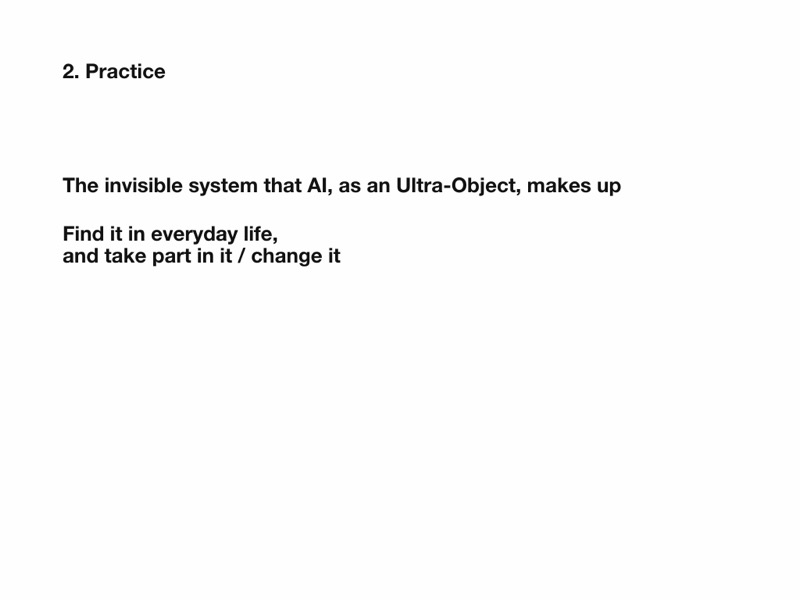
Facing such an object from such a stance, the question that falls to the artist is: what can be done? The direction the course offers is: make the invisible visible. Not translating the inside of AI into attractive illustrations, but making the scattered parts, the hidden relations and the ongoing actions visible.
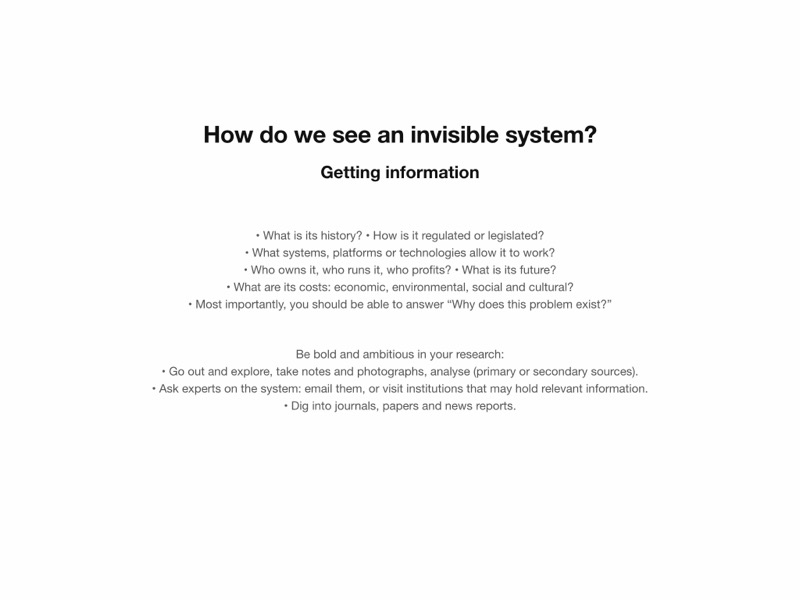
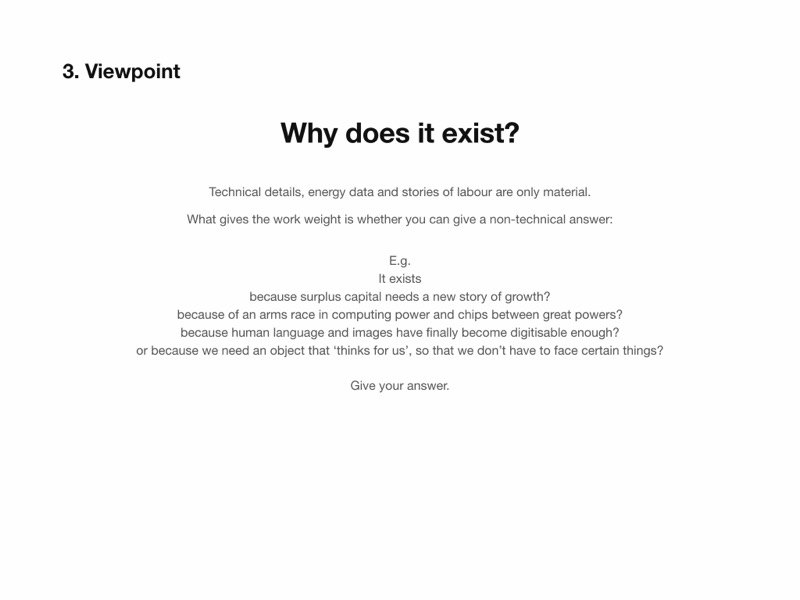
From this direction, the course named its way of working diagrammatic thinking. It consists of three moves. Trace: follow the object’s materials and relations all the way through your research: its history, what it runs on, who owns and maintains it. Draw: put the relations you have traced into a diagram; what to draw and what not to draw are choices, and every diagram is a statement of position. Question: finally, answer a non-technical question: why does it exist? Who profits from it, who is counted in, who is left out? At this point the technical question becomes a political and ethical one. Crawford’s anatomy, Latour’s network and Deleuze’s felt are different forms of this thinking. The diagram is not an exhibit; it is a method.
The three shifts finally land in the course’s two assignments: one co-creating with AI through Vibe Coding, the other using diagrammatic thinking to trace an Ultra-Object. The assignments are not an appendix to the argument but where the argument arrives. The two assignments and the answers handed in by six students will be presented in the next instalment.
Further reading
- Kate Crawford, Atlas of AI (Yale University Press, 2021)
- Benjamin Bratton, The Stack: On Software and Sovereignty (MIT Press, 2015)
- Andrew Pickering, The Cybernetic Brain: Sketches of Another Future (University of Chicago Press, 2010)
- Jane Bennett, Vibrant Matter: A Political Ecology of Things (Duke University Press, 2010)
- Gilles Deleuze & Félix Guattari, A Thousand Plateaus, chapter 14
This essay is compiled from the content of the course AI Life-Objects. Names of theories and works keep their original English at first mention, so that readers can look them up.