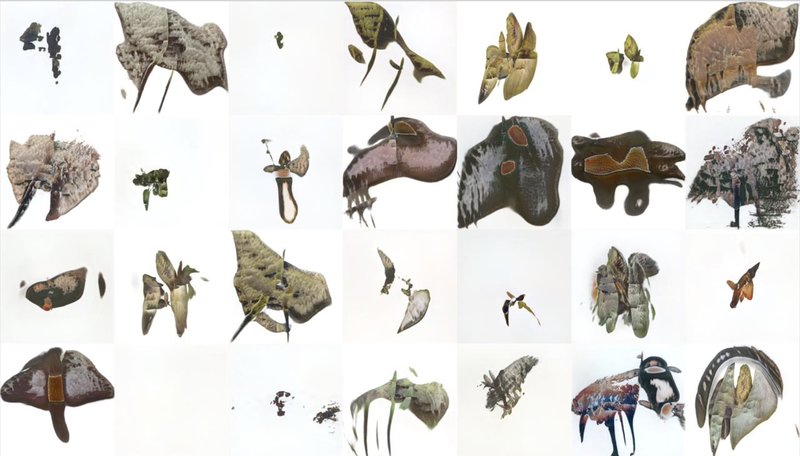
Infinity Species Generator began as a website that continuously assembled unfamiliar organisms from biological image sources. Each generated image was accompanied by a name derived from its contributing sources, then entered an expanding online population. The work’s nineteen-minute rhythm gave the system a duration beyond a single viewing session: species appeared whether or not anyone was present to watch them.
The project emerged during the 2020 lockdown, when physical access to studios and exhibitions was interrupted. Within Transformation & Transmission, an online exhibition of work from MA Interaction Design Communication at London College of Communication, the browser was not only a substitute display space. It became the work’s habitat. Generation, naming, accumulation and public access occurred in the same technical environment.
The artificial organisms are neither scientific proposals nor illustrations of future biotechnology. They expose how a database already contains a particular world: which species have been photographed, how they are labelled, and what kinds of difference can be recombined by an algorithm. The apparent abundance of generated life therefore remains entangled with the limits and histories of its sources.
This early work established several questions that continue in Ren’s practice. What happens when a technical system acts beyond the duration of direct human attention? How do categories and interfaces produce the nonhuman beings they claim merely to organise? And where is authorship located when images emerge through a relation among collected data, code, model and viewer?
Later versions of the project developed through new models and moving-image forms. This Journal entry keeps the 2020 website version distinct because it was the version publicly presented by Ars Electronica and because its browser-based ecology remains a clear starting point for Ren’s ongoing work on human and nonhuman systems.