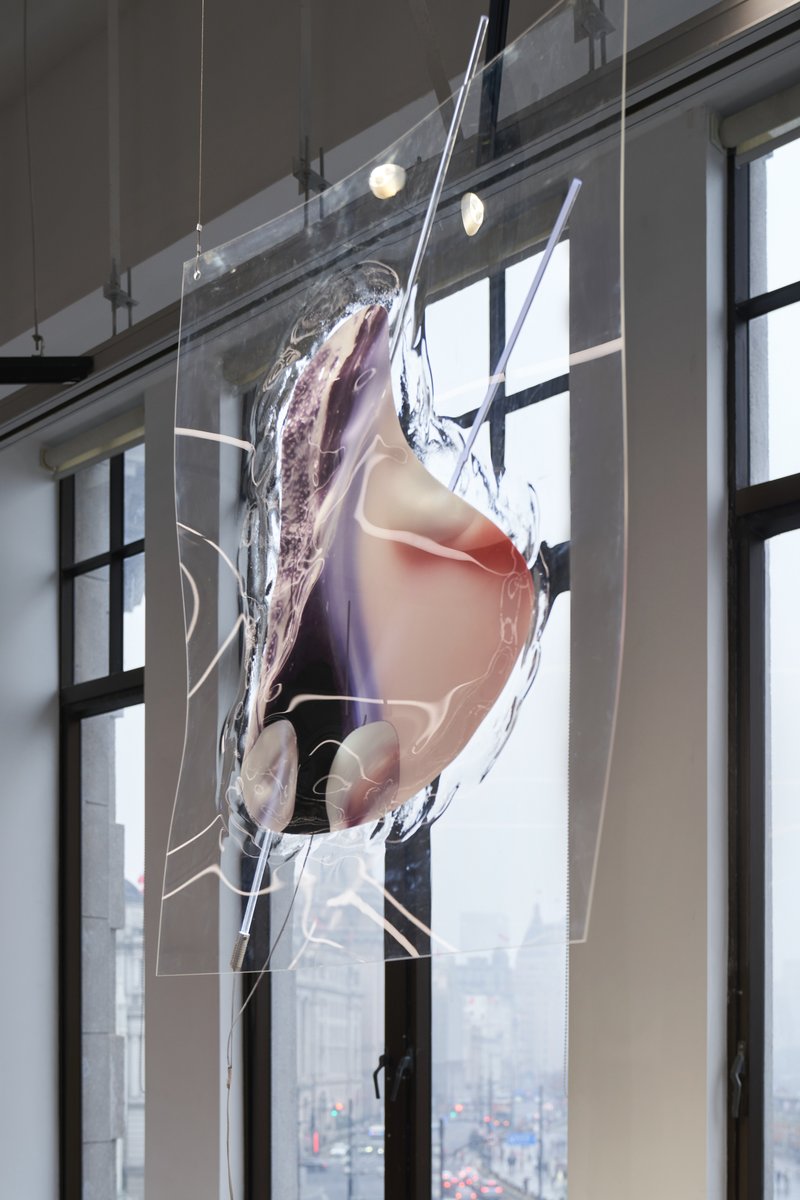
Electronic Eucharist began with the apparent disappearance of the body inside contemporary communication. A finger moves across glass while the interface suppresses most of the tactile event, delivering image and information as if the network had no weight. The series returns touch to that scene and asks what kind of body is being formed when communication depends on systems that remain largely imperceptible.
The installations combine acrylic, glass, resin, Fresnel lenses, welding fixtures and other industrial elements. Soft or wax-like surfaces meet hardware used to hold, transmit or focus. These materials do not illustrate a seamless merger of human and machine. They keep the contact uneasy: touch encounters a system that both extends the body and cuts into it.
The title borrows the structure of a sacrament without proposing a new religion. It names a system through which separated individuals imagine becoming connected to a larger whole. In networked life, that promise is mediated by cables, chips, standards and interfaces. The system’s apparent silence can make it seem more powerful than the people who depend on it to communicate.
This work established a question that continues through Ren’s later practice: where does a human body remain when its perception and action are distributed across nonhuman actors? Electronic Eucharist answers neither with nostalgia for an unmediated body nor with celebration of disembodiment. Instead, it holds the carbon–silicon relation open as a material and political tension.
Its 2024 presentation at Hanart TZ Gallery placed the series within an exhibition about bodies altered through encounters with mechanical and other forms of life. That context made visible the ethical dimension already present in the materials: technical mediation does not simply connect bodies; it changes the terms on which bodies can sense, appear and act.