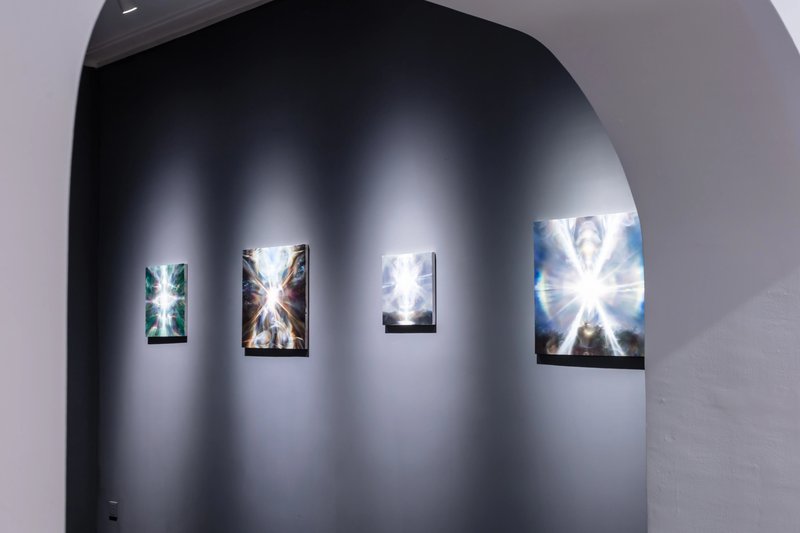
Summon belongs to a painting series begun in 2024. The works are made with acrylic on tempera-prepared wooden panels, combining dense surface texture with a light that appears computational, layered and difficult to locate in physical space. The image carries traces of diffusion-based image generation and machine vision, yet it is rebuilt through slow, manual painting.
This translation between screen and panel is central to Ruoxi Ren’s practice. The work does not oppose digital simulation to authentic human sight. It asks how both have already formed one another. For a generation whose visual memory was shaped by screens, synthetic light can produce recognition, attraction and even a sense of transcendence before it refers to anything in the physical world.
The exhibition State of Ecstasy used trance as an entry into altered states of perception. Across installation, moving image, sound and performance, it considered how technical media and structures of belief shape contemporary experiences of ritual, attention and estrangement. Summon entered this context as a materially painted image of impossible light: an interface between calculation and embodied looking.
The record is included in the Journal because it marks another position of the body within a technical system. Here the body is not captured as data or asked to approve an agent’s action. It is the viewing body, learning to recognise a light that belongs equally to painting, simulation and machine-readable images.