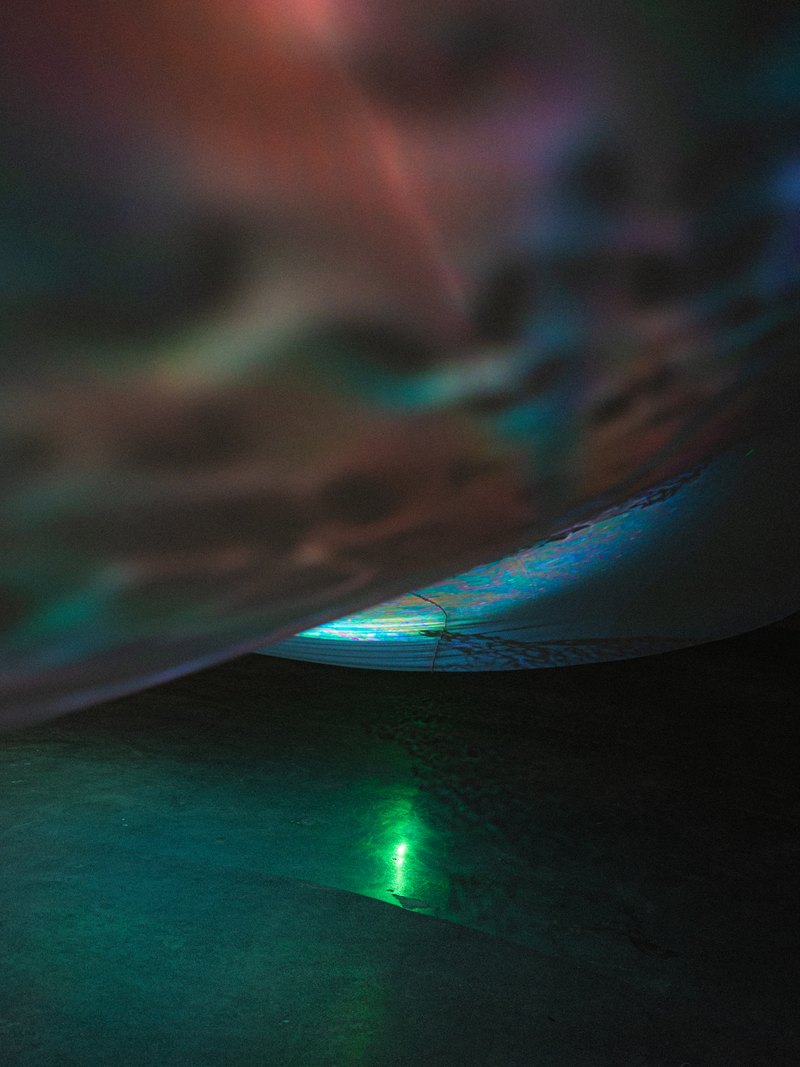
The moment we entered the gallery, we realized we were no longer standing on the stable coordinates of land. Here, wet ontology was not a theory on paper but a flowing texture diffused through the space: three-dimensional, humid, shifting. Seawater, light, sound and installation interlaced; they were no longer background or props, but presences actively shaping human perception. Scent molecules hovered in the air, barely there, like a faint glow spilling from a fishing village on a damp night, drawing us, as we breathed, into an “unnatural” state.
The experience Adrienne Rich describes in Diving into the Wreck became tangible here. Wearing the “diving gear” of technology, we entered the tension of the sea together with the viewers. The logic and hierarchies of land ceased to hold. Light was not merely illumination; in this space it became a force that lures and guides, letting us share a phototactic instinct with the nonhuman life around us. Just as the squid’s approach is not a “choice,” the viewer’s path here had already been quietly set by technology and environment.
The “lures” hang between presence and absence. They seem to call, yet offer no clear direction; they are like signals from the deep sea, and like a virtual illusion within the spectrum of information. Each movement of a viewer may trigger a response from another living being. We are no longer the centre of this field but a possible disturbance. A viewer’s approach may be another’s retreat; a viewer’s pause may become another creature’s trajectory. The boundaries between human and nonhuman, perception and technology, active and passive, keep dissolving and recombining.
We gradually understood that the exhibition was not meant to offer a clear narrative, but to let our bodies and the viewers’ undergo a “sensory entrapment” together. The interplay of faint light and scent reminds us that so-called active perception has already been shaped by environment and technology; responses that seem autonomous are often echoes of an underlying system. In this wet ecological theatre, the tensions among people, things, machines and living beings are amplified, and at the same time woven into a new order.
This is not a representation of the ocean, but a summoning of “wet being.” It asks us, together with the viewers, to leave the certainties of land and enter a process of continual differentiation, dissolution and recomposition. There we no longer separate ourselves from others; we drift with light, sound, scent and technology, becoming part of an ecological network.
The “lures” the artists created lie between existence and non-existence, perceptual illusions drafted by a technical system. They touch the instinctive responses of deep-sea creatures, and connect with the human experience of drifting through visual culture, information spectra and sensory regimes. In this ecological theatre we did not arrive at an answer; we only drifted with the unknown. Drifting is not loss, but a way of meeting others, the environment and ourselves again within uncertainty.