Sangong topic discussion 2 | Semiotics theory
In the context of contemporary art, signs are not only a tool for conveying information; they are a key element in constructing meaning, expressing emotion and exploring identity. We began our discussion of signs with two physical objects: the Phaistos Disc and NASA’s Golden Record.
The Phaistos Disc lay buried deep in the earth for centuries. It was discovered in 1908 and is thought to date from around 1700 BCE. Forty-five distinct signs are inscribed on this round disc of fired clay. It has been read as a poem, a scripture, a magical inscription or a piece of music from four thousand years ago, even as humanity’s oldest punctuation, and its signs have still not been fully deciphered. Answering it is the 12-inch gold-plated record made by NASA, which carries sounds of nature, pieces of music and greetings in 55 languages. It was sent into interstellar space fifty years ago aboard Voyager 1 and 2, and has become one of the most distant objects humans have made. Both show how signs work across different cultures and histories, becoming bridges between human experience and the universe.
Although these two objects belong to different historical and technical contexts, both are products of media technology. Both carry information recorded in a spiral, and both exceed their original material form. Both are signs produced by a kind of ethnographic visual narrative; these narratives are subjective and provocative, and they capture visual traces of the Anthropocene. What lets them go beyond their material existence is the sign. Signs allow them to exceed themselves and to gain the capacity to pass information to whoever interprets or decodes them.
So, returning to the present: what do signs mean for young artists who grew up in the digital age and perceive the world through screens? In Symbolic Exchange and Death, the French philosopher Jean Baudrillard proposed his theory of simulacra: everything exists and is perceived in media, and the postmodern world will be a hyperreal world governed by models and signs (simulacra), in which the hyperreal replaces the real. Today we already live in a visually oriented world. Images and media shape our thinking and perception as never before, and reading habits are gradually shifting from text to images. These images also shape how artists understand and construct the real world, and they become part of artists’ lives. In such a hyperreal digital world, how do we observe the present and reflect on how contemporary signs are constructed and spread? And how do we find personal and cultural functions within complex sign systems?
Can contemporary art use semiotics to create a universal expression that goes beyond language, beyond cultural boundaries and beyond human-centred narratives? Sometimes the subject of art is personal experience hidden in a private narrative. How do signs work then?
Text / Ruoxi Ren
Discussion | Semiotics theory
We started from the foundations of modern semiotics to explore how signs are used in contemporary art. Following the development of modern semiotic theory, we looked at the theories of Ferdinand de Saussure and Charles Sanders Peirce, including signifier and signified, and icon, index and symbol, and we discussed and practised how contemporary artists use and create new sign systems.
In this study we focused on interpreting several parts of Peirce’s semiotics, above all the triadic, dynamic sign process. Peirce’s work on logic and phenomenology is highly original. Compared with the binary theory of Saussure’s structuralism, Peirce’s account of signs has more fluid energy and more room for interpretation, and it can analyse and explain all kinds of signifying phenomena, including signs in art. A rigorous chain of logical reasoning lies behind Peirce’s classification of signs; to some extent his sign theory is a kind of “phenomenology of signs”. It is a good reference for analysing and making artworks, and it stirs the imagination.
The aim of this topic was not to treat semiotics as a tool for thinking about art, or as a standard of analysis. We refuse fixed ways of thinking and single right answers. Instead, we take it as a new logical starting point to provoke discussion and thought: what else could semiotics be? How else could art use it?
Guided reading of semiotic theory | Semiotics theory
In class we read pages 108 to 115 of Design Theory To Go closely and, following the author’s approach, focused on these parts of Peirce’s semiotics:
1. Two worlds
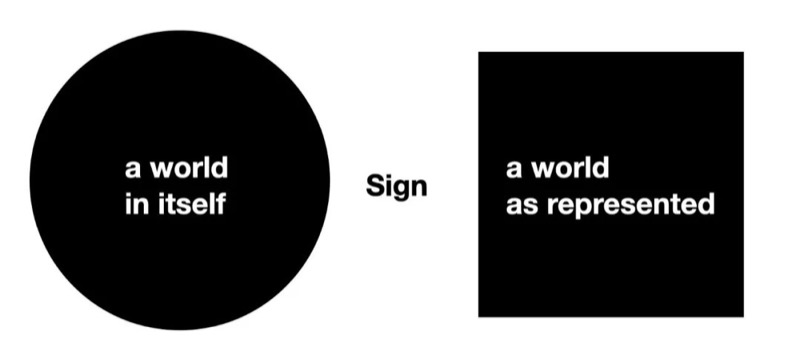
There are two worlds. These two worlds, the real world and the represented world, are linked through the mediating role of signs.
“semiotic functioning” (Parmentier, 1994, 9–10). “There is to be sure, a world in itself and a world as represented, but Peirce’s fundamental insight is that these two realms are brought into articulation by the mediating role of signs” (Parmentier, 1994, 23).
2. The ground
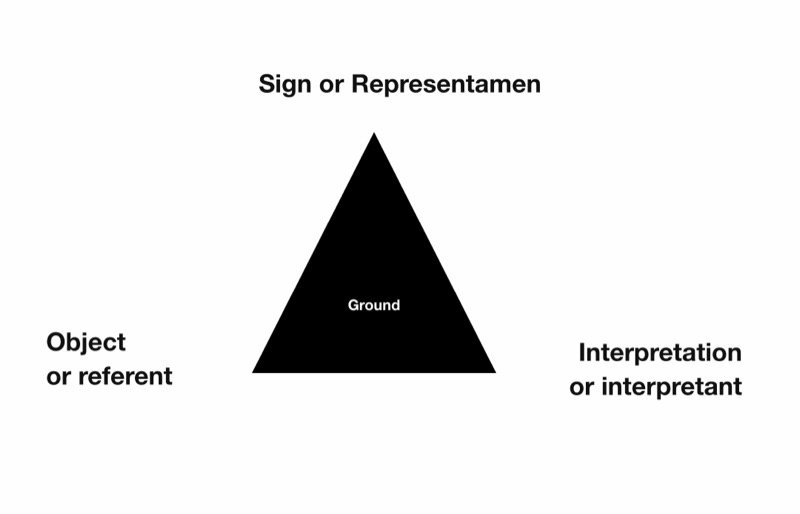
Peirce’s semiotics uses rigorous logic to connect knowledge with the structure of communication. Here a concept is introduced in spatial terms: the “ground”. This space can vary in size, but it always exists. He held that the object of interest determines the sign that represents it, and that there must be a “grounding connection” between sign and object, called here the “ground”. A sign can only work if it is understood as a sign standing for something else. Recognising a sign requires interpretation, and the “ground” is the basis for that interpretation. If an image is not read as a sign, it can only be seen, to some degree, as an image pointing to itself.
“The interpretant is the translation, explanation, meaning, or conceptualization of the sign-object relation in a subsequent sign representing the same object; a sign which is highly determined is one which offers little latitude of interpretation” (1994, 51).
“So there must be some kind of principled linkage or reason, what Peirce called ‘the ground,’ between the two if the sign is to become a mediated realization of the object in this process of constantly developing knowledge-communication” (Parmentier, 1994, 4).
3. Icon, index and symbol
In Charles Sanders Peirce’s semiotics, signs fall into three basic types: icon, index and symbol. An icon signifies through resemblance between the sign vehicle and its object (as a portrait or a map does). An index signifies through direct contiguity or a causal relation between the sign vehicle and its object (as a symptom does). A symbol signifies through law or arbitrary social convention.
3.1 Icon
An icon is a sign that resembles its object or shares features with it. In other words, the image connects directly to what it represents through shape, colour or other sensory features. A painting, a photograph or a map, for example, are all iconic signs, because they visually resemble what they refer to.
3.2 Index
An index is a sign with a direct causal or physical relation to its object. It “points” to the object in some way, usually through existence or association. Smoke, for example, is an index of fire, because the appearance of smoke usually means that there is a fire; the height of the mercury in a thermometer indicates temperature. Such signs can be connected to their objects directly through observation and experience.
3.3 Symbol
A symbol represents its object through social convention or habit. Its meaning does not come from a direct connection to the object but from cultural or linguistic convention. Letters, words and traffic signs, for example, are all symbols, because their meanings are set by the conventions of a community, not by direct resemblance or a causal relation to what they refer to.
3.4 Mixed sign systems (system dimensions)
Find the anomaly: imagine this as a scene from everyday life in which an index, having lost its usual context, turns into a symbol.
4. The triadic sign process
The triadic, dynamic sign process proposed by Charles Sanders Peirce is the core of his semiotics. It explains how sign, object and interpretant relate to and act on one another. To me, this is precisely the most innovative part of his theory, and the part most inspiring for making art.
This triadic relation can be understood as “standing for something, to someone, in some capacity”. It means that a sign is a relation among the sign vehicle (the sign’s concrete physical form), the object (the aspect of the world that carries the sign’s meaning) and the interpretant (the meaning of the sign as the interpreter understands it).
The three elements interact as in the diagram below:
- The sign points to the object: the sign represents the object in some way.
- The object gives rise to interpretation: through the sign, the object prompts the interpreter’s understanding.
- The interpretant feeds back into the sign: the interpreter’s understanding may in turn affect further understanding of the sign and the object.
The most beautiful thing about this logic is that it lets me feel that signs are “alive”. Here we no longer reduce every representation of a sign to a so-called immediate object. The most important representation is the representation of a dynamic object, and the dynamic object is continually confirmed through intersubjective relations.
Within this logic, could we see the world as a vast store of information, in which lived experience or artistic invention is a dynamic sign process happening at every moment?
Related works / Reference
Joseph Kosuth, One and Three Chairs, 1965
Sol LeWitt used the name conceptual art in 1967 to “describe work like his own, ‘intended to engage the viewer’”. Discussed here: Joseph Kosuth’s One and Three Chairs (1965) and its relationship to conceptual art. The work is ideal for explaining key identifying aspects of conceptual art, such as dematerialisation and documentation. It continues to influence conceptualism’s documentation, its use of language and its attitude to the unique art object. It helped shape conceptual art and influenced work in the years that followed.
There are different interpretations of the semantic and ontological aspects of this work. Some read it through the relation between ideal forms and the material world in Book X of Plato’s Republic; others refer to Ludwig Wittgenstein’s Tractatus Logico-Philosophicus. Others still, like Dreher, discuss the semantics of One and Three Chairs and see it as an inclusion of circles representing semantic fields.
Here we can try to analyse it with Charles Sanders Peirce’s triad of icon, index and symbol. The work illustrates the triadic sign theory perfectly. The photograph of the chair, as an icon, conveys meaning through visual resemblance; the physical chair, as an index, points directly to its physical existence and function; and the dictionary definition, as a linguistic sign (symbol), carries a conceptual meaning set by social convention. Together the three forms of sign make up a complete expression of the object “chair”.
Of course, as we make multiple readings of the work, we have already moved away from the so-called “real world” and built several “represented worlds”. From this, can we infer that interpreting an artwork is not about searching for meaning itself, but about the context in which meaning appears, and its position and relations within a network of knowledge structures? From this perspective, as long as human understanding keeps developing and contexts keep changing, “meaning” will be interpreted forever and never fully resolved; it will always be sliding along the chain of meaning. The innovation of artistic practice may lie in this very process: continually breaking through the existing ground, and linking, cutting, weaving, adding to or erasing different chains of meaning…
We can observe that while artists use signs and give them new interpretants, artworks are also given new interpretants by culture. For example, the pink foreleg of the dog in Pierre Huyghe’s work, a new sign created by the artist, was circulated again and flowed into everyday life, becoming one of the internet’s memes.
In this practice we will create a sign system of our own. We treat the “sign” as a dynamic, living material that will act as an effective medium of communication between author and audience, and we will try to create a field that can be perceived and experienced.
We question the form, content, meaning, use and benefit of the “sign”. Nothing is off limits.
Text / Ruoxi Ren